
Transcatheter Aortic Valve Replacement (TAVR)
Contact Us
Transcatheter Aortic Valve Replacement, commonly called TAVR, is a minimally invasive, catheter-based procedure to replace a diseased aortic valve without open-heart surgery. TAVR is offered at Saint Francis Hospital through the Trinity Health Of New England Structural Heart Program for patients with severe aortic stenosis and a clinical indication for aortic valve replacement. The procedure is performed in the cardiac catheterization laboratory.
What is severe aortic stenosis?
The aortic valve sits between the heart’s main pumping chamber (left ventricle) and the aorta, the large artery that carries oxygen-rich blood to the rest of the body. In aortic stenosis, this valve becomes thickened and narrowed—most often from age-related calcium build-up—so the heart has to work harder to push blood through it. Over time, severe aortic stenosis can cause shortness of breath, chest discomfort, fatigue, lightheadedness or fainting, and heart failure. Without treatment, severe aortic stenosis significantly shortens life expectancy.
How does the TAVR procedure work?
TAVR is performed in a hybrid catheterization laboratory by a multidisciplinary Heart Team that includes interventional cardiologists, cardiac surgeons, imaging cardiologists, and specialized nurses. A catheter is inserted into an artery—most commonly in the groin (the femoral artery)—and advanced to the heart. A new replacement valve, made of biological tissue mounted on a flexible frame, is collapsed within the catheter and guided into position inside the diseased aortic valve. The new valve is then expanded into place, where it immediately takes over the work of the old valve. The diseased valve is not removed; the new valve is anchored within it.
Because TAVR avoids the chest incision, breastbone splitting, and heart-lung machine required for traditional open surgery, most patients recover more quickly, have a shorter hospital stay, and return to normal activities sooner.
Who is a candidate for TAVR?
TAVR is offered to patients with severe aortic stenosis and a clinical indication for aortic valve replacement. Candidacy is determined by the Heart Team after a thorough evaluation that typically includes an echocardiogram, a cardiac CT scan, a coronary angiogram, and review of overall health and other medical conditions. The Heart Team works together with you and your referring physician to recommend the treatment approach—TAVR or surgical aortic valve replacement—that is best suited to your individual situation.
What to expect after TAVR
Most patients are out of bed the same day or the morning after the procedure and are discharged home within one to two days. Your care team will review activity, medications (including blood thinners), and follow-up imaging before you leave the hospital. Cardiac rehabilitation is often recommended to help you safely return to full activity.
To learn more about TAVR and the Structural Heart Program at Saint Francis Hospital, call 860-714-1265.
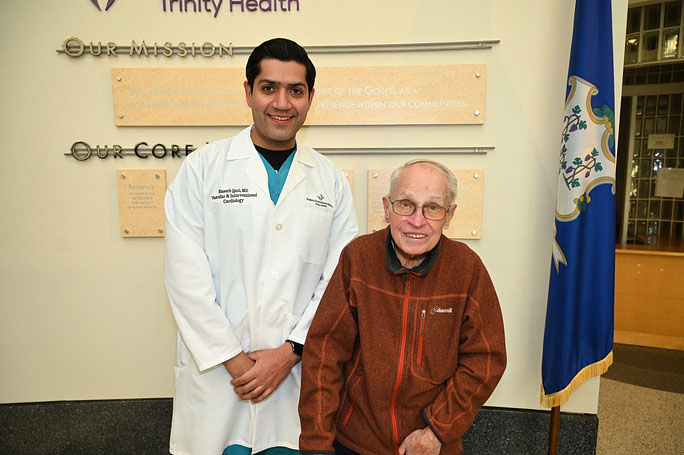
“I’ve always felt not just cared for at Saint Francis Hospital, but cared about.”
When Wayne needed a Transcatheter Aortic Valve Replacement (TAVR), he became part of history—the 1,000th TAVR procedure performed at Saint Francis Hospital. The milestone procedure was led by Abdul Qazi, M.D., Interventional Cardiologist, and the Structural Heart team. TAVR offers an effective alternative to traditional open-heart surgery for patients with aortic valve disease.
At 91-years of age, Wayne was recently seen for his 1-year follow-up after his valve replacement. He is doing well after the procedure and even made time to reconnect with Dr. Qazi and the team that saw him through his TAVR procedure.